Sio kweli. Mungiki walikuwa police? Hata kama polisi walihusika, walufanys hivyo kwa utii wao kwa makabila yao na sio order ya Rais wa Wakati huo.Polisi walihusika.
Kuna report inasema 37% waliuawa kwa kupigwa Risas na Polisi.
Maafisa wa ICC wapo nchini
You are using an out of date browser. It may not display this or other websites correctly.
You should upgrade or use an alternative browser.
Maafisa wa ICC wapo nchini
- Thread starter kimsboy
- Start date
"...miaka mine" inatoka wapi? Akiamua kuendelea, kama anavyofanya anayemuiga (Museveni), utamzuia vipi?Kwa uraratibu wa ICC, hawapendi kumkamata kiongozi ambaye yupo madarakani, ila akimaliza tu, wanahama naye. Bado miaka 4.
Na kwa upande wa pili, unajuwa vipi kuwa juhudi za waTanzania za kumwajibisha kwa uovu wake hazitafanikiwa wakati wowote kabla ya hiyo minne unayomtakia wewe!

cocastic
JF-Expert Member
- Nov 30, 2019
- 124,486
- 205,109
😂😂😂 ujue nacheka sana, kumbe huwa unakua mpole eeh?hutaki taratibu ama?

jmushi1
Platinum Member
- Nov 2, 2007
- 26,621
- 25,985
Ndiyo maana Sasa hiyo order sidhani kama matokeo tuliyoyaona yanaweza ku justify mauwaji yale.Polisi ni kweli walizingua.
Ila ile ni order.
Nimekukumbusha ya Tesha, nitakuambia na lingne pia labda hulifahamu, wanajeshi walikuwa wako upande wa Raia na kama maandamano yangeenda siku ya 2 na ya 3. Hii nchi ingekuwa chini ya Jeshi.
Siku ya 1 Wanajeshi hawakugusa Raia hata mmoja. Walikuwa wanawalinda.
Kosa la Raia ni kuanza kuchoma ofisi za umma. Sheli na stand za mwendokasi.
Ila maandamano yangekuwa bila kuharibu mali.
Basi Wanajesh wangetuunga mkono.
Huko jeshin pia kuna makundi na mpasuko.
Una habar pia kuna Watu walikuwa wanaenda kuiteka TBC?.
Sasa hii intelejensia unafikiri Raisi hakuwa nayo?.
Kesi ya kujibu ipo kwa maoni yangu.

Tlaatlaah
JF-Expert Member
- May 18, 2023
- 53,282
- 42,423
napomuelekeza mdau wa jf jambo fulani, lazima niende nae taratibu😂😂😂 ujue nacheka sana, kumbe huwa unakua mpole eeh?
cocastic
JF-Expert Member
- Nov 30, 2019
- 124,486
- 205,109
Sawa sawa, 😂😂😂napomuelekeza mdau wa jf jambo fulani, lazima niende nae taratibu

Castle_Lite
JF-Expert Member
- Sep 10, 2016
- 4,980
- 11,294
Sio kweli. Mungiki walikuwa police? Hata kama polisi walihusika, walufanys hivyo kwa utii wao kwa makabila yao na sio order ya Rais wa Wakati huo.
Ripoti kuu iliyochunguza mauaji ya baada ya uchaguzi mkuu wa Kenya wa mwaka 2007/2008 ni Ripoti ya Tume ya Waki (Waki Commission Report), rasmi ikijulikana kama Commission of Inquiry into Post-Election Violence (CIPEV). Ripoti hiyo iliyowasilishwa Oktoba 2008 ilibaini kuwa watu 1,133 waliuawa, ambapo watu 406 walipigwa risasi na kufa mikononi mwa polisi chini ya mazingira yasiyoeleweka.
Jinsi Polisi Walivyohusika Kulingana na Ripoti (Waki na UN)
- Mauaji ya Kupigwa Risasi (Asilimia 35.8 ya Vifo Vyote). Ripoti ya Tume ya Waki ilionyesha kuwa polisi walihusika moja kwa moja na mauaji ya takriban watu 406 kwa kuwafyatulia risasi za moto waandamanaji na raia wasio na hatia,....
Tlaatlaah
JF-Expert Member
- May 18, 2023
- 53,282
- 42,423
sawaSawa sawa, 😂😂😂

Gypsum Screw
JF-Expert Member
- Jun 10, 2024
- 1,644
- 1,965
Yaani atawarudisha aliowaua na kuwateka sioSijui ila bado naamini Samia ana nafasi yakurudi kwa wananchi na kuresolve na watu waka move on!Tumpeni muda

EvilSpirit
JF-Expert Member
- Jun 15, 2017
- 13,625
- 21,510
Nimeipenda style yao ni kama mwizi anavyonyata aibe
Unajilisha upepo. Kesi ya Tanzania ni tofauti na kenya. Kenya vikundi viwili tofauti vilivyokuwa na mirengo tofauti ya kisiasa vilishambuliana na kuuwana kwa kuchochewa na wanasiasa- you are right.Icc haitafuti aliyeua. Inatafuta aliyehusika na kusababisha mauaji. Either kwa amri au kuchochea.
Mfano mzuri ni hapo Kenya.
Mauaji ilikuwa kipindi cha uchaguzi, 2007, watu karibia 1000+ waliuawa.
Uhuru Kenyata na Ruto wote walikuwa ni viongozi wa vyama vya Siasa.
Raisi alikuwa ni Mwaikibaki.
Polisi waliua Raia kwa Risasi na pia Raia wengne waliuana kwa kutumia silaha za jadi.
Ila guess what?. Waliofikishwa ICC ni Ruto na Kenyata.
Viongozi wa Kisiasa.
Sio raisi. (Mwaikibaki).
Kuna mtangazaji wa Radio pia alishtakiwa kuhamasisha hayo mauaji ya Kenya. Ingawa yeye hakuua mtu. Ila kauli zake zilihamasisha yale mauaji.
Now, umeshaona ni kwa namna gani Lissu na wanaharakati watajumuishwa kwenye hili. Alafu Raisi pamoja na vyombo vya Usalama wataachwa.
Hapa kwetu raia waliandamana- ingawa pia vibaka wali-take advantage, serikali au mamlaka zilizo amriwa na serika zikavunja maandamano yale brutally. Kulikuwa na nafasi ya kutumia risasi za mpira, mabomu yamachozi, maji washawasha etc kudhibiti maandamano yale, sababu waandamanaji hawakuwa na silaha- hakuna ushahidi wa polisi waliojerubiwa au kuuwawa. Kenya waandamanaji walibeba silaha wakashambulia jamii tofauti.
Sasa hapa kwetu uchungu utakuwa na lengo la kbainisha mambo kadhaa, mosi nani waliua wale raia? nani alitoa amri- shoot to kill? nani alificha maiti? zilifichwa wapi? je, ni kweli kuna majeruhi mahututi waliochanganywa na maiti wakabebwa na maori kupelekwa kusikojulikana?
Icc investigations are normally impartial, independent and robust. Sio kama ile judiciary ambayo iko compromised, au polisi isiyojua mwajiri wake ni nani- chama cha siasa au wananchi.

Lisa Rina
JF-Expert Member
- Dec 3, 2010
- 3,391
- 7,416
Kuomba msamaha itasaisda ku heal watu kdgYaani atawarudisha aliowaua na kuwateka sio
Kubwa Jinga. Sasa unadhani wamekuja kuisimamisha nchi.Wanakushughulisha kama huna kazi ya kufanya, lakini wanakuja na wataondoka ,Tanzania ipo palepale.Kwani Wanakuja wangapi hapa nchini na kuondoka na hutuacha kama walivyotukuta. Ya Lissu yamefikia hatma, sasa simulizi ni ICC!!!Nashangaa kwanini Gerson Msigwa anavyopenda kupost kila habari hili hajalipost kabisa.
Nina taarifa za kuaminika kabisa kuwa maafisa wa mahakama wa kimataifa ya ICC wapo hapa Tanzania yapata siku ya tatu sasa.
Na taarifa zinadai kuwa wameenda nyumba nyeupe na wamefanya mahojiano na Rais Samia
Hii habari ni ya kweli 100% nina uhakika nayo kabisa
SunCity South Africa
The ICC leadership visited South Africa to strengthen cooperation and discuss matters relating to the Court. The discussions provided South Africa an opportunity to reaffirm its commitment to the ICC and emphasize the need to protect the Court's independence
Maneno mazito kupitia hotuba ya mheshimiea rais Cyril Ramaphosa wa South Africa mbele ya vigogo wa ICC kwa mtawala haramu Samia, washauri wake chawa Hamza S. Johari, Palamagamba Kabudi, wakuu wa vyombo vya kutoa haki na usalama Tanzania :Wanampa nafasi ya haki kwa mtuhumiwa Samia aongee na washauri wake kina Johari S. Hamza ili akifika ICC The Hague asije na hoja hakupewa nafasi ya kujitayarisha kujibu mashtaka yanayomkabili ya mauaji na sifa ya kutojali (impunity).
HOTUBA YA CYRIL RAMAPHOSA :
12 November 2026
Sun City
North West Province
Republic of South Africa
Address by President Cyril Ramaphosa at the International Conference on Access to Justice, Sun City Convention Centre, North West
: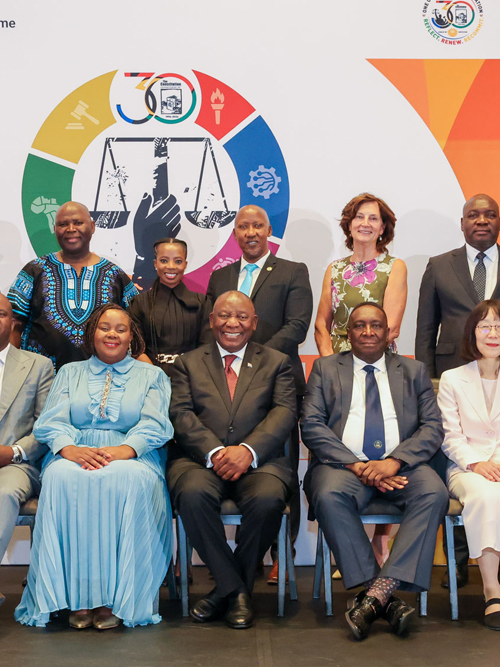
Thursday, 12 November 2026
Programme Director,
Minister of Justice and Constitutional Development, Ms Mmamoloko Kubayi,
Ministers and Deputy Ministers,
Premier of the North West, Mr Lazarus Kagiso Mokgosi,
Deputy Chief Justice, Justice Dunstan Mlambo,
President of the International Criminal Court, Judge Tomoko Akane,
Chairperson of the African Commission on Human and Peoples’ Rights, Hon Idrissa Sow,
Executive Director of the United Nations Office on Drugs and Crime, Dr Monica Juma,
Members of the judiciary,
Representatives of international and regional organisations,
Members of the Diplomatic Corps,
Distinguished Delegates,
Ladies and Gentlemen,
Dumelang. Sanibonani. Molweni. Goeie dag.
It is a great pleasure to welcome you to South Africa and to this important international gathering on access to justice.
We are honoured to be joined by distinguished representatives of the judiciary, governments, international institutions, the legal profession and civil society from across the world.
You have come together around a question that goes to the very heart of democracy, human rights and human dignity.
What does justice mean to a person who has rights under the law, but lacks the means to exercise them?
What does justice mean to a woman who suffers violence but fears that the institutions meant to protect her will fail her?
What does justice mean to a worker who is unfairly dismissed but cannot afford legal representation?
What does justice mean to a rural community whose land and resources are threatened, but which has neither the knowledge nor the means to defend its interests?
And what does justice mean to a poor person who is exploited by those with greater wealth, influence and power?
These are not merely legal questions.
They are profoundly human questions.
They speak to the relationship between the citizen and the State, between the powerful and the powerless, and between the promises of democracy and the realities of people's lives.
They remind us that justice cannot be measured only by the strength of our constitutions, the independence of our courts or the sophistication of our legal systems.
It must ultimately be measured by whether the ordinary person can secure protection, obtain redress and live with dignity.
This is why the theme of this conference, 'Strengthening People-Centred Justice Systems: Deepening Democracy', is so important.
It challenges us to place people, rather than institutions alone, at the centre of our understanding of justice.
Ladies and Gentlemen,
This gathering takes place at a significant moment in South Africa's history.
Next month, we will commemorate thirty years since President Nelson Mandela signed our democratic Constitution into law.
It was an extraordinary moment in the life of our nation.
For generations, the law in South Africa had been used to enforce racial oppression, dispossession and exclusion.
It determined where people could live, where they could work, whom they could marry, what education they could receive and whether they could participate in the political life of their own country.
The law was used not to protect the dignity of all, but to preserve the privileges of a few.
The struggle against apartheid was therefore not only a struggle for political freedom.
It was a struggle to fundamentally change the meaning and purpose of the law.
It was a struggle to replace a system that denied human dignity with one that placed human dignity at the centre of our national life.
When we adopted our Constitution, we made a solemn commitment that never again would the law be used as an instrument of oppression.
The father of our democracy Nelson Mandela put it much more successfully when he said “"Never, never and never again shall it be that this beautiful land will again experience the oppression of one by another and suffer the indignity of being the skunk of the world."
We committed ourselves to a society founded on human dignity, equality, freedom and the rule of law.
We established independent courts and institutions to safeguard these values and to hold public power accountable.
We affirmed that every person, regardless of race, gender, wealth or social standing, was entitled to equal protection under the law.
And we affirmed a principle that remains fundamental to our democracy: no person, no institution and no government is above the law.
Our constitutional journey has been enriched by the experience and support of the international community.
Our Constitution drew on the wisdom of constitutional traditions from across the world, just as our own experience has contributed to the development of human rights jurisprudence internationally.
We are grateful to the many countries, institutions and organisations that have supported South Africa's democratic and constitutional development.
But as we reflect on thirty years of constitutional democracy, we must also confront an uncomfortable truth.
The existence of constitutional rights does not, by itself, guarantee that people will enjoy those rights.
A person may have the right to equality and yet experience discrimination.
A person may have the right to dignity and yet endure violence and humiliation.
A person may have the right to access the courts and yet be unable to afford a lawyer, travel to a courthouse or navigate complicated legal procedures.
And a person may live in a constitutional democracy while experiencing injustice in almost every aspect of daily life.
This is the gap that we must close.
It is the gap between the promise of justice and the experience of justice.
It is a gap that exists in countries both rich and poor, in established democracies and in emerging democracies.
And unless we close it, we risk weakening the very foundations upon which democratic societies are built.
For when people repeatedly experience injustice, they begin to lose confidence not only in the institutions of justice, but in democracy itself.
When the poor believe that the law protects the wealthy and powerful but offers them little protection, the legitimacy of our institutions is diminished.
When corruption goes unpunished, when criminality is tolerated and when the powerful evade accountability, public trust is eroded.
Justice that is inaccessible is justice that is denied. And justice that is delayed, corrupted or reserved for the privileged undermines democracy itself.
We live at a time when the principles of justice and international law are being severely tested.
Across the world, millions of people continue to suffer the consequences of war, conflict, displacement, discrimination and economic exclusion.
In too many places, civilians bear the greatest burden of conflict, while those responsible for grave violations of human rights and international humanitarian law escape accountability.
We are witnessing growing challenges to the institutions and principles established to protect humanity from the abuse of power.
We must therefore reaffirm our commitment to the international rule of law.
International law must apply equally to all nations.
Human rights must be defended consistently.
The protection of civilians, the pursuit of accountability and respect for human dignity cannot depend on the political influence, economic strength or strategic importance of the parties involved.
There cannot be one standard of justice for the powerful and another for the weak.
The credibility of the international legal order depends on its fairness, its consistency and its independence.
As South Africa, we remain committed to multilateralism, the peaceful resolution of disputes and the strengthening of international institutions that advance justice and human rights.
We believe that respect for international law is essential to building a more peaceful, just and equitable world.
Yet our commitment to justice must extend beyond the great questions of international relations and constitutional law.
It must reach into the everyday lives of our people.
For many people, injustice is not experienced in the form of a constitutional crisis or an international dispute.
It is experienced when a worker is denied wages that have been earned.
It is experienced when a family is unlawfully evicted from its home.
It is experienced when a consumer is trapped in an exploitative lending arrangement.
It is experienced when a child is denied maintenance, when a woman cannot obtain protection from an abusive partner, or when an elderly person is cheated out of their savings.
It is experienced when communities are denied basic services, when public resources are stolen through corruption, and when those entrusted with enforcing the law become perpetrators of criminality themselves.
These may appear to be individual injustices.
But when they are repeated across millions of lives, they become a profound social and democratic failure.
We must therefore broaden our understanding of access to justice.
It cannot be limited to the ability to approach a court.
It must include the ability to understand one's rights, to obtain assistance, to challenge abuses of power and to secure an effective remedy.
It must also include the ability to resolve disputes without being drawn into costly, lengthy and intimidating legal processes.
A justice system must not only be open to the people. It must work for the people.
One of the greatest obstacles to justice is poverty.
Poverty limits people's choices, weakens their bargaining power and exposes them to exploitation.
It often means that a person cannot afford to challenge an unlawful decision, confront an abusive employer or seek compensation for a wrong suffered.
In such circumstances, formal equality before the law can coexist with profound inequality in the ability to use the law.
We must confront this contradiction.
We cannot claim to have achieved equal justice if a wealthy person can pursue a legal remedy for years while a poor person is forced to abandon a legitimate claim because they cannot afford to continue.
We cannot speak of meaningful access to justice if geography, language, disability, education or economic circumstances determine whether a person can exercise their rights.
And we cannot regard justice as complete if the institutions meant to protect the vulnerable are themselves inaccessible, unresponsive or indifferent.
This places a particular responsibility on governments.
We must ensure that our justice systems are adequately resourced, efficient, independent and responsive.
We must strengthen legal aid, support community-based legal services and make legal information accessible in languages and forms that people can understand.
We must ensure that women, children, persons with disabilities, rural communities and other vulnerable groups can obtain protection and redress.
In South Africa, Legal Aid South Africa plays a vital role in providing legal representation to those who cannot afford it.
Our Equality Courts provide mechanisms through which people can challenge unfair discrimination, harassment and hate speech.
Community advice offices, civil society organisations and public interest legal practitioners continue to perform indispensable work in helping people understand and enforce their rights.
We recognise the important contribution of the legal profession, including those firms and practitioners that provide pro bono services to disadvantaged communities.
We are also working to make greater use of technology, digital services and alternative dispute resolution to reduce the cost and complexity of accessing justice.
But we must be clear about our purpose.
Technology must not create a new divide between those who are digitally connected and those who are excluded.
Legal reforms must not merely make our institutions more efficient on paper.
They must make justice more accessible in practice.
The test of every reform must be whether it improves the experience of the person seeking justice.
There is another dimension of access to justice that deserves greater attention.
It is the relationship between economic power and justice.
In many societies, including our own, economic inequality is accompanied by unequal access to legal protection.
Those with substantial resources are often better able to defend their interests, pursue litigation and influence the circumstances in which disputes are resolved.
Those without resources are frequently compelled to accept injustice because they have no realistic alternative.
We must not allow economic power to become a shield against accountability.
Whether injustice is committed by the State, a corporation, an employer, a financial institution or an individual, the law must provide effective protection and redress.
This requires strong and independent courts.
It also requires effective regulators, accessible complaints mechanisms, fair labour institutions, consumer protection and competition authorities, and a legal profession committed to the public good.
It requires us to recognise that the pursuit of justice is inseparable from the struggle against poverty, inequality and exclusion.
A society cannot be truly just when the ability to defend one's rights is determined by the size of one's bank account.
This is why access to justice must be central to our efforts to build more inclusive economies and more equal societies.
It must be seen not as a narrow responsibility of justice ministries and legal institutions, but as an essential part of democratic governance and social development.
As we gather at this conference, we should resist the temptation to measure progress only by the number of laws we have passed, the institutions we have established or the policies we have adopted.
These are important.
But they are not enough.
Our people do not experience justice as a policy document or a legislative achievement.
They experience justice when a dispute is resolved fairly.
They experience justice when a perpetrator is held accountable.
They experience justice when their property, livelihood or family is protected.
They experience justice when they can approach a public institution and be treated with respect.
And they experience justice when they know that their rights matter, regardless of who they are or how much they possess.
That is why this conference must be more than an exchange of ideas and experiences.
It must produce a practical agenda for change.
I would urge this gathering to give particular attention to three priorities.
The first is to make justice genuinely accessible to the poor and vulnerable.
This means reducing the financial, geographical, procedural and other barriers that prevent people from obtaining legal assistance and effective remedies.
The second is to build justice institutions that are independent, accountable, efficient and worthy of public confidence.
This requires us to confront corruption, strengthen professional integrity and ensure that the administration of justice is not undermined by political interference or the abuse of power.
The third is to establish meaningful ways of measuring whether justice systems are improving people's lives.
We need to know not only how many cases our courts process, but how long people wait for justice, what it costs them, whether outcomes are fair and whether those outcomes are effectively enforced.
We need to understand why people abandon legitimate claims, why vulnerable communities struggle to obtain assistance and why some groups remain excluded from the protection of the law.
We must learn from countries and institutions that have found innovative ways to bring justice closer to the people.
And we must translate that learning into practical reforms that can be implemented, monitored and sustained.
I would welcome an outcome from this conference that provides governments, judicial institutions and international partners with a clear framework for advancing people-centred justice.
Let this be a gathering that moves us from declarations to implementation, from commitments to measurable progress, and from the promise of justice to its practical realisation.
There is a particular significance in our gathering here at Sun City.
During the apartheid era, Sun City became internationally associated with a system of racial segregation and inequality.
It was a place that symbolised, for many around the world, the contradictions and injustices of apartheid South Africa.
Artists and activists across the world used the name of Sun City to draw attention to the injustice of apartheid and to mobilise international solidarity with the struggle for freedom.
Today, representatives of nations and institutions from across the world are gathered here to advance justice, equality and human dignity.
There is something profoundly meaningful in this transformation.
It reminds us that history is not immutable.
That institutions and societies can change.
That injustice, however deeply entrenched, can be overcome through the courage, determination and solidarity of people.
And that places once associated with exclusion can become places where we affirm our common humanity.
Thirty years ago, South Africa adopted a Constitution that promised justice, dignity and equality for all.
That promise remains the foundation of our democracy.
But it is also a promise that must be renewed through our actions every day.
We owe it to those who struggled for freedom.
We owe it to those who continue to suffer injustice.
And we owe it to future generations who should inherit a world in which rights are not merely proclaimed, but are respected and protected.
Let this conference affirm a simple but powerful principle.
Justice must never be the privilege of the few. It must be the right and the lived experience of all.
Let us build justice systems that serve the people rather than intimidate them.
Let us build institutions that protect the vulnerable rather than favour the powerful.
Let us ensure that the law is an instrument of dignity, equality and freedom, rather than exclusion and oppression.
And let us work together to build a world in which every person, regardless of their circumstances, can stand before the law with confidence that they will be heard, treated fairly and afforded justice.
For the true strength of a democracy is not measured by the power of its institutions alone.
It is measured by how those institutions protect the rights and dignity of the most vulnerable members of society.
I wish you fruitful deliberations and a successful conference.
I thank you
Castle_Lite
JF-Expert Member
- Sep 10, 2016
- 4,980
- 11,294
Mm siungi mkono Jinsi serikali nserikali au mamlaka zilizo amriwa na serika zikavunja maandamano yale brutally.
Vyombo vyake vya Dola vilivyoshughulikia lile suala.
Ila kusema Icc watawachukulia hatua Raisi na vyombo vya Usalama ni kujipa matumaini hewa.
Report iliyopelekwa mezani kwa Raisi inamuambia kuwa yale sio maandamano. Bali ni vurugu zilizokuwa na lengo la kufanya mapinduzi ya serikali. Na serikali ilichukua hatua inayowezekana kuyazuaia.
Wataonyesha na athar za kuchomwa ofisi za umma, sheli , magar na mwendokasi. Na pia kuna taarifa za kiintelejensia kuwa Jeshi lingeungana na Raia. Na kuna clip ilitoka kuwa Jeshi linahimiza Raia kutoka.
Kwa namna hii. Unafikiri kuna mtu atashtakiwa?.
Yale ya Kenya pamoja na yote hayo. Hakuna aliyepatwa na hatia na Kesi ilifutwa. Sembuse hii ya kwetu ambayo wao serikali wanasema kuna chembe chembe ya mapinduzi walikuwa wanazuia?.
Kwahiyo ndugu zangu. Tusijipe matumaini hewa ya serikali kuwajibishwa.
Sanasana naona wanapiga sumbersort kuwalengesha watu wengne kwenye hili suala.
ScapeGoat.
Hizi siasa ni mbaya sana.
RESILIENT KATO
JF-Expert Member
- Aug 21, 2024
- 4,686
- 9,314
Huku Bongo wanahangaika na chadema plus upinzani hawana attention to detail za usalama!ndio maana Marais wa Africa ni rahisi kufa kizembeDuh! Ndo maana yule Kiduku wa North Korea huwa haachi kinyesi wala mkojo. Anafungasha vyote na kila alichogusa kinafutwa. Kabla haijaondoka, timu yake ya ulinzi huwa ina kazi kubwa sana😀

Crocodiletooth
JF-Expert Member
- Oct 28, 2012
- 23,396
- 28,742
But,for diplomacy we have,they shall be answered well accordingly and went away softly... Tanzania kwa vikao vya meza kwa meza hakuna wa kutuweza tumeiva kweli.Tumeshaanza tyr 😄 😄
RESILIENT KATO
JF-Expert Member
- Aug 21, 2024
- 4,686
- 9,314
Hapana hata CIA,mossad,M16 plus mashirika yote ya kijasusi duniani yanajua!!hiyo ni anatomy plus chemical technology!!Yaani teknolojia ya kushut down mwili imeshapatikana toka Urusi.

residentura
JF-Expert Member
- Mar 1, 2017
- 10,390
- 15,279
Kumbe nawe unamfuatilia Rachel Dangwa!!!???sasa nimegundua huna akili, umeitoa hii habari kwa recho dangwa mtu ambaye anatamani mabaya yatokee kwa nchi, msemaji wa serikali hawezi kupost huo upuuzi wa recho dangwa, huyo mdada alisema twaha anavushwa namanga je ulimuona?
Yaani mtu akurupuke na uzushi halafu serikali ijibu si itakuwa ujinga huo, kwahiyo hata maria na hilda walivyozusha rais mara kafa mara anaumwa ulitaka serikali ijibu ili wajione wakubwa wanajibiwa na serikali.
hizo habari za icc zimezushwa sana
Kumbe ni kweli viazi wa CCM ndio wafuatiliaji wakubwa wa Mange na Rachel!!!!
residentura
JF-Expert Member
- Mar 1, 2017
- 10,390
- 15,279
Amen.Mungu saidia haki za ndugu zetu waliouawa zipatikane na wahusika wote kuanzia juu mpaka chini wapate stahiki zao. Amen
Similar Discussions
-
 Tuna ugeni wa maafisa wa ICC tokea jumapili
- Started by kimsboy
- Replies: 4
-
Marekani Yakunjua Makucha Yake.Yawawekea Vikwazo Vikali Maafisa Mbalimbali Wa ICC . Yaapa Kupambana Na Mahakama Hiyo Hadi Kieleweke.
- Started by Lucas Mwashambwa
- Replies: 30
-
Sammy Awami aeleza sababu ICC kumpiku Lissu tuzo ya Umoja wa Ulaya
- Started by carbohydates
- Replies: 10
-
